Lekarze
How to reduce emotional distance in the doctor-patient relationship in online communication?
Share


%201.svg)
In the previous article we have shown why human proximity remains crucial in healthcare, even in the age of artificial intelligence.
In recent years, digital care has become an integral part of healthcare. On the one hand, it gives patients quick access to a doctor, on the other - it often raises concerns about the “dehumanization” of relations. Many specialists note that lack of physical presence, time constraints or technological barriers can deepen the emotional distance between doctor and patient. In this article, we look at practical ways in which, in everyday online work, a doctor can build empathy and reduce emotional distance in the relationship with the patient.
The results of a 2024 study published in JAMA, indicate that a physician's empathy can have a direct impact on the health of patients struggling with chronic pain. Patients who rated their physician as particularly empathetic experienced significant reductions in pain severity, improved functioning, and improved quality of life (12-month follow-up) [1]. This is also supported by data from a comprehensive systematic review of 455 studies, which found that physician empathy is consistently associated with better clinical outcomes and higher patient satisfaction [2]. Importantly, as many as 80% of educational interventions aimed at developing empathy have proven to be effective, proving that empathy is not just a personality trait, but a skill that can be developed [2].
The conclusion?
Empathy in healthcare is not only an ethical requirement, but also an effective therapeutic tool. As shown by practical experience and analyzes, when doctors treat the patient with kindness and understanding, this directly affects the relief of symptoms, improvement of functioning and overall quality of life.
Preliminary studies indicate that patients rate doctors' level of empathy during telecounseling similar to in-patient visits [3]. Importantly, after an empathetic online consultation, patients experience less anxiety and milder perception of their symptoms [4].
Here are 3 key elements that can increase empathy when providing digital care services:
Maintaining the continuity of the relationship is crucial. Even small forms of contact (so-called microinteractions) can significantly increase the patient's sense of presence and involvement. In a retrospective study of asynchronous consultations, the average empathy score was as high as 8.93 out of 10. What the patient remembers are often small gestures, short messages that show that he is “seen” and that someone accompanies him in the treatment process.
What is worth doing?
Examples of microinteractions:
The empathy and attentiveness of the doctor is not enough if the patient is not sure that his data and privacy are adequately protected. The most common threats in digital care relate to three areas [6]:
How can you support the patient?
It is essential that consultations take place on telemedicine platforms designed specifically for services that meet strict legal standards, use secure login and encryption mechanisms, and clearly inform the patient who has access to their data and for what purpose. Transparency and security are not an addition to telemedicine, but an absolute prerequisite.
Technology is just a tool - the quality of care is decided by a person. Studies of remote monitoring of patients struggling with chronic conditions show that patients feel more confident when they know who is responsible for individual elements of their care, and the team clearly communicates the division of roles [7]. Educating patients and staff allows you to understand the limitations of the system and know when you need to contact a doctor immediately.
What is worth doing?
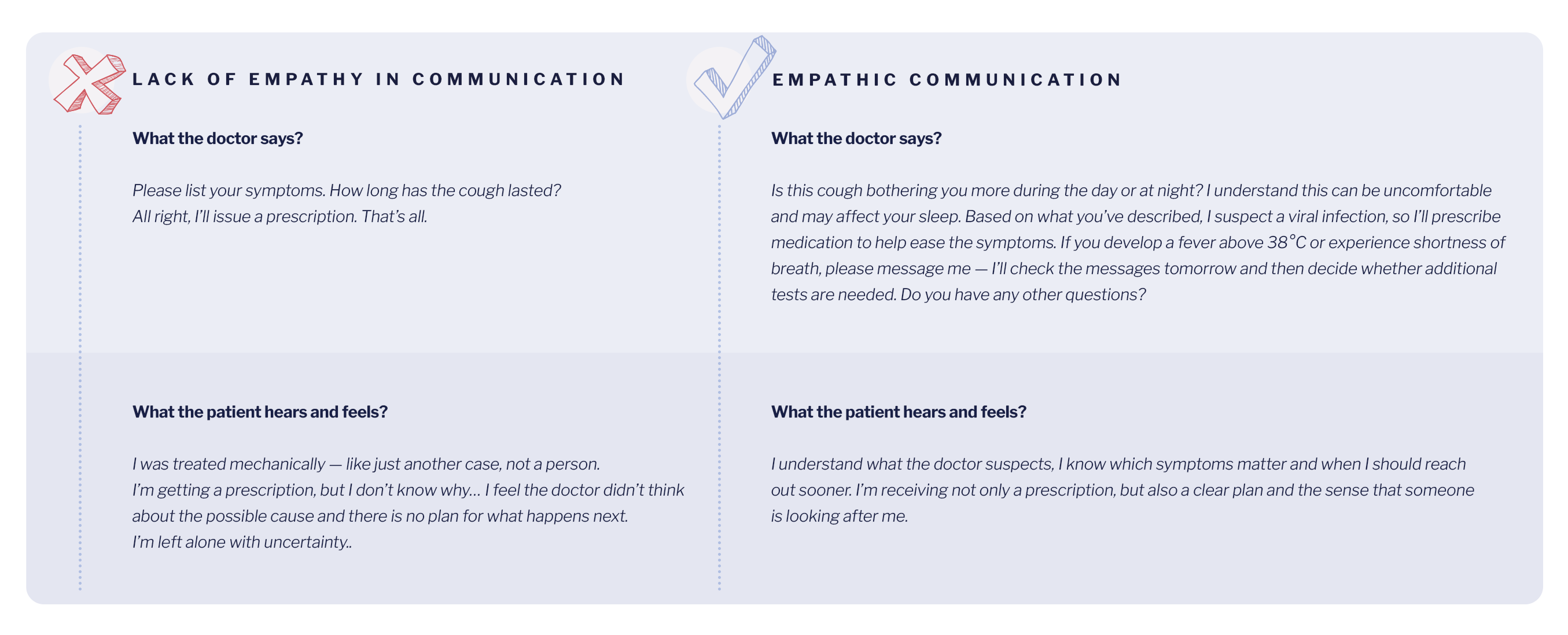
We have prepared a short checklist, which can support daily contact with the patient. These are some simple steps that make it easier to maintain empathy and clarity in the conversation, without lengthening it unnecessarily.
Greeting
Building a sense of security
Empathic communication
End of consultation
Digital care is changing the way we interact with patients, but it doesn't have to weaken relationships. Thanks to empathy, transparency and continuity of contact, you can build a sense of closeness, security and trust, which are the foundation of effective treatment. Empathy in digital care is not a theory, but a practice that can be realized through conscious habits.
[1]https://pmc.ncbi.nlm.nih.gov/articles/PMC11009829/
[2]https://pmc.ncbi.nlm.nih.gov/articles/PMC10012244/
[3]https://journals.stfm.org/primer/2024/subramanya-2023-0125
[5]https://ata2024.mapyourshow.com/mys_shared/ata2024/handouts/3_1200PM_AT1_RO31_Miranda.pdf
[7]https://bmchealthservres.biomedcentral.com/articles/10.1186/s12913-023-09428-1